
Consent

This site uses third party services that need your consent. Learn more

Skip to content
EX
VAT
INC
VAT
Shop now
Login

Understanding Infrared Heating

What is Infrared Heating?

Hands held up to the sun Women enjoying sunshine in field Woman feeling warmth of sun through the window

What Is Infrared Heating?

Infrared heating is a form of radiant heat that warms people and surfaces directly rather than heating the air first.

It is the same type of heat naturally experienced from the sun, comfortable and immediate, but engineered and controlled for modern buildings.

Unlike traditional convection heating systems that rely on warming and circulating air, infrared transfers energy directly to solid surfaces. These surfaces then release warmth back into the space, creating stable and consistent comfort.

Because heat is delivered where it is needed rather than continuously heating air, infrared is increasingly used across residential, commercial and industrial environments.

Understanding Radiant Heat

Heat moves in three main ways:

Conduction

Through direct contact

Convection

Through moving air

Raditation

Through electromagnetic waves

Infrared heating uses radiation.

Radiant energy travels through the air and is absorbed by solid materials such as walls, floors, furniture and people. These materials warm up and gradually release heat back into the environment.

This is a key difference from convection systems, where air must continually be reheated as it moves and escapes. By warming surfaces instead, infrared creates a more stable heat profile within a space.

Diagram comparing convection and infrared heat.

How Infrared Heating Works in Practice

Traditional heating systems warm the air first. Warm air rises towards the ceiling, cool air drops, and the system cycles repeatedly to maintain temperature.

Infrared heating behaves differently.

Radiant energy is absorbed directly by people and objects. As surfaces warm, they become secondary heat emitters, helping to stabilise comfort across the space.

This creates a natural feeling of warmth that differs from conventional systems.

Because air is not the primary heating medium:


Warmth is felt quickly

Air movement is reduced

Comfort can often be achieved at lower air temperatures

Infrared Heating in Real Buildings

Infrared heating is used across a wide range of environments because it allows heat to be targeted according to how spaces are actually used.

Warehouses and industrial buildings

Infrared helps reduce energy loss associated with large air volumes and high ceilings.

Warehouse Heating Solutions

Wellness environments

Gentle radiant warmth supports comfort-focused spaces.

Hot Yoga & Spas

Outdoor or semi open areas

Radiant heat remains effective where air-based heating would quickly disperse.

Heating Outdoor Spaces

This flexibility is one of the reasons infrared heating is increasingly considered in modern building design.

Wavelength and Performance

Infrared energy exists across a range of wavelengths, and each behaves differently depending on environment and application.

Long-wave infrared is typically associated with gentle comfort heating in occupied indoor spaces.

Medium-wave and short-wave infrared produce more intense radiant energy and are often used where heat needs to travel further, respond quickly or perform in challenging environments.

Understanding wavelength behaviour is important because infrared heating is not a single technology.

Performance depends on selecting the right type of radiant heat for the space.

Thermal Mass and Heat Stability

When radiant energy warms surfaces such as walls, floors and furniture, those materials store heat and gradually release it back into the space.

This process, often described as thermal mass, helps create stable comfort and reduces temperature swings.

As a result, spaces heated with infrared can often feel comfortable even when air temperatures are lower than those required with convection-based heating.

Why Quality Matters

Not all infrared heaters perform in the same way.

Performance depends on factors such as:

Emitter design

Radiant efficiency

Material construction

Surface temperature management

Higher-quality systems are engineered to provide consistent radiant output and long service life, which is especially important in commercial or continuous-use environments.

Some premium systems, including EIHA-accredited panels, are independently assessed against recognised standards for radiant performance.

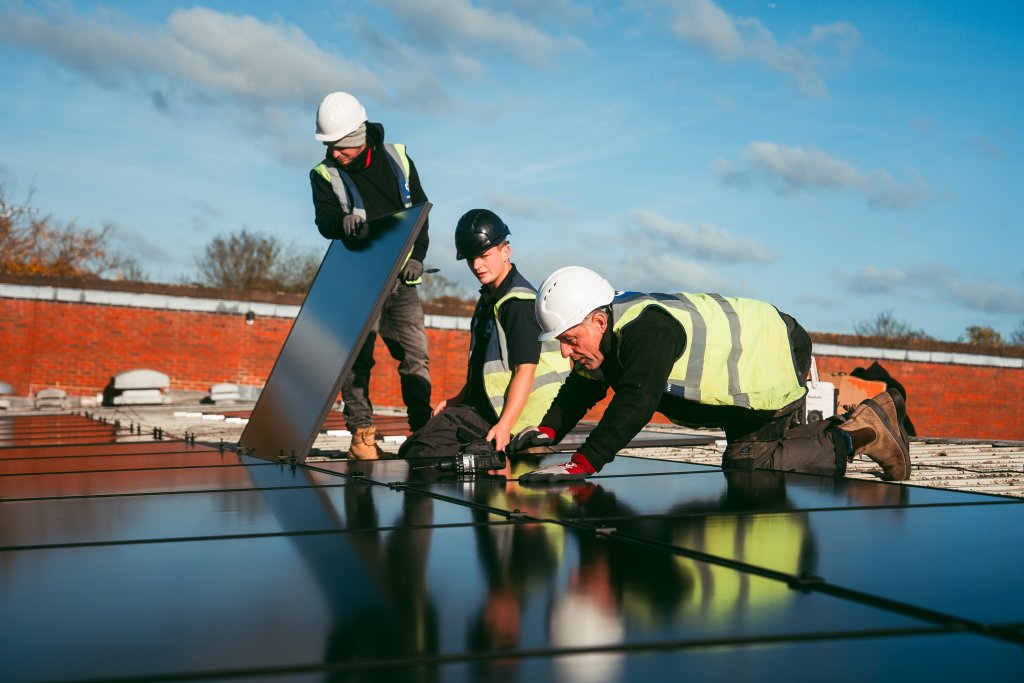
Solar PV Installation.

Infrared Heating and Energy Strategy

Because infrared heating is electric, it fits well within modern energy strategies.

When correctly designed, infrared systems allow heating to be aligned more closely with building use, helping reduce unnecessary energy consumption.

This can include:


Heating only occupied areas rather than entire building volumes

Is Infrared Heating Right for Every Space?

Infrared heating works best when systems are designed around real building use.

Important considerations include:

Occupancy patterns

Ceiling height and layout

Mounting position

Insulation levels

Intended use of the space

Correct specification ensures the right type of infrared heating is used in the right environment, which is essential for long-term comfort and performance.

Want to learn more about infrared heating or discuss a project?

Continue exploring our infrared heating guides to deepen your understanding, or speak with our team if you would like advice tailored to your space.